


The Americano is one of the most ordered coffee drinks in the world.
But it’s also one of the most misunderstood. I think that’s a shame. It does deserve some intellectual consideration.
A while ago, I spent months testing how to make the perfect Americano. The main lesson was that two things really decide the cup: coffee strength and water.
Not the espresso machine 🙅♂️
I’d even put the espresso machine behind the grinder here…
So asking which coffee machine is best for Americano might seem a bit silly. But it actually isn’t. Because my idea of an “Americano” opens up some untraditional, but very convenient solutions.
To me, Americano is more of a beverage strength than a brewing method. It’s a metal-filtered coffee that’s stronger than drip coffee, but you can get there in many different ways.
Below are my top picks. After that, the details on why.
Straight to the Point
For most people, the Breville Bambino is the best machine for Americano. If you don’t want to dial in espresso at all, the Essenza Mini already makes coffee close to Americano strength.
- Best overall: Breville Bambino (Sage Bambino in UK/EU). Fast, small, and the steam wand does double duty: hot water and steamed water
- Best with a built-in grinder: Breville Barista Express. Everything in one box, including a dedicated hot water outlet
- Easiest: DeLonghi Essenza Mini (Nespresso). The shots are already close to Americano strength
- Best budget: Bialetti Moka Express. Cheap, lasts forever, dilute about 1:1
- Best for travel: Outin Nano. Pull a long shot anywhere
What actually makes a good Americano
1. Strength
An Americano is espresso plus hot water. Simple. But how much water?
That depends on how strong your coffee is to begin with. And this is where most people go wrong.
Coffee strength is measured as TDS (total dissolved solids). A 10% TDS espresso is 10% coffee solids and 90% water. Drip coffee usually sits around 1.4%.

Personally, I enjoy an Americano anywhere between 1.8% and 2.5%. Chocolate-forward coffees taste better on the stronger end, fruity ones with more dilution.
The math is simple:
Final strength = Starting strength ÷ (1 + parts of water)
So a 10% espresso diluted 1:3 lands at 10 ÷ 4 = 2.5%.
Now the interesting part. Different brewers start at very different strengths:
| Brewer | Starting strength (TDS) | Dilution for ~2-2.5% |
|---|---|---|
| Espresso, 1:2 ratio | ~10% | 1:3 to 1:4 |
| Moka pot | ~4-5% | about 1:1 |
| Nespresso, 40 g shot | ~2.5-2.8% | none, just program a longer shot |
| AeroPress, 1:10 | ~2.5% [TK: measure] | none at 1:10; about 1:1 at 1:5 |
This is why a moka pot or a capsule machine can make a perfectly decent Americano. You just add less water.
2. Water
At 2% strength, your Americano is about 98% water. Yet most people obsess over beans and grind size, and then use whatever comes out of the hot water tap for dilution.
That’s a mistake… at least with some machines.
Espresso machines with a steam boiler keep water hot for days. Every time you steam, pure water leaves as vapour and the minerals stay behind. Bicarbonate builds up, and too much bicarbonate makes coffee taste flat and muted.
Water that sits in an espresso boiler can also pick up off-flavours from metal parts, gaskets and old coffee oils.
If you don’t trust me, pull some water from the group head, let it cool down and taste it.
Kettle, steam wand or hot water spout?
So IMHO water from the espresso machine is actually detrimental to your americano. So what to do instead?
Here are some solid options:
- The kettle. My default recommendation. Heat fresh, soft water, ideally low in bicarbonates. If you don’t have a KH test kit, water around 10-50 TDS is a good choice.
- Steamed water. James Hoffmann recently showed a technique I hadn’t thought of. Put fresh cold water in a jug, heat it with the steam wand to around 65-70°C, then brew the espresso on top.
In his blind tastings, the steamed water beat both the machine’s hot water and the kettle. He isn’t sure why. His best guess is dissolved gases.
The part that makes sense to me: steam is basically pure water vapour, so steaming fresh water shouldn’t drag the concentrated boiler minerals into your cup. A little extra water condenses in, that’s all.
I tested it, and I like the result. To me, it gives a slightly rounder taste.
But for me, the bigger win is heating the water in a separate kettle and making sure it’s very soft water. - The hot water spout. Convenient, and not always bad. Machines with a thermoblock or thermocoil, like the Bambino and Barista Express, heat fresh water from the tank on demand. So there’s no mineral build-up like in a steam boiler.
- You still get water that has travelled through the machine, though. If you want the best cup, use the kettle or the steam wand.
One more thing on temperature. Hoffmann aims for 65-70°C. Personally, I find that slightly hot, and I prefer my Americano a bit cooler. If you like it piping hot, the kettle gives you full control.
Don’t skimp on the grinder
If you use an espresso machine, the grinder has a big effect on your Americano. Probably bigger than most people expect.
This is where a lot of people cut corners. They spend the budget on the machine and pair it with a cheap grinder that wasn’t made for espresso.
A grinder that produces a lot of fines (coffee dust) can add bitterness and harshness. And dilution doesn’t hide that; if anything, bitterness tends to stand out more in an Americano than in an espresso.
You don’t need to spend a fortune, though. See what I recommend in my guide to the best cheap coffee grinders and my espresso grinder guide.
The best coffee machines for Americano
1: Breville Bambino Plus

The Bambino (sold as Sage Bambino in the UK and EU) is a small espresso machine with a thermojet heater. It doesn’t really require any heat up time. It’s ready in about 3 seconds, which makes it one of my favorite espresso machines ever.
It doesn’t have a traditional hot water spout. However, with the machine in ready mode, press the 1 CUP and STEAM buttons at the same time, and the steam wand dispenses hot water instead.
On the Bambino Plus, it’s 1 CUP and the Milk Foam (Froth Level) button. The same wand also lets you use Hoffmann’s steamed-water trick.
You’ll need a separate grinder (more on that above).
Overall, the Bambino Plus is a fantastic espresso maker, whether you’re brewing milk drinks, traditional espresso shots or a an americano/long black.
Check Price2: Breville Barista Express

Grinder, espresso machine and dedicated hot water outlet in one box. It heats with a thermocoil, so the hot water comes fresh from the tank.
However, it’s a traditional espresso machine. You still need to dial in your shots, and the built-in grinder is the weak link.
it’s a good machine for people who don’t want to go all-in geek-mode. there’s a reason it’s one of the most sold espresso makers in the world
Read my full Barista Express review.
Check Price3: DeLonghi Essenza Mini

This Nespresso machine surprised me when I tested it. A standard 40-gram shot from the Essenza Mini came in at 2.83% TDS.
That’s not espresso strength. It’s more or less Americano strength.
So this is not an espresso maker; I’d rather call it an Americano maker!
The advantage of the Nespresso system is that it’s very easy to dial in. The more water runs through the capsule, the weaker the coffee. Hold the button down while it brews, release when you want, and the machine remembers that volume.
So program a slightly longer shot, and you quickly end up in Americano range. No dilution needed.
By the way, Nespresso has its own slightly inflated way of naming things. Their lungo is roughly regular drip coffee strength. Their espresso sits somewhere between a traditional lungo and an Americano, and their ristretto is still weaker than a regular espresso.
So Americano strength is somewhere between their espresso and lungo settings.
There’s no hot water function, but you don’t really need on, since you’ll just run all the brew water through the capsule.
The machine is tiny (about 11 cm wide), heats up in about 25 seconds and takes third-party capsules.
Overall, I think it’s a very convenient machine if you’re looking for americano strength coffee most of the time.
Read my full Essenza Mini review.
Check Price4: Bialetti Moka Express: best budget

Moka pot coffee is roughly 4-5% TDS. Strong, but nowhere near espresso.
So dilute about 1:1, and you land around 2-2.5%. Right in the Americano sweet spot.
There’s no paper filter, so you get more oils and a bit of sediment. A heavier cup, and little to no crema.
Purists will say it isn’t an Americano. Fair. But in the cup, it’s close.
It’s cheap and lasts forever. Just keep in mind the classic aluminium version doesn’t work on induction.
Available in many different sizes; from single serve moka coffee maker and all the way to an 18 cup jumbo size.
Read my full Moka Express review.
Check Price5: Outin Nano
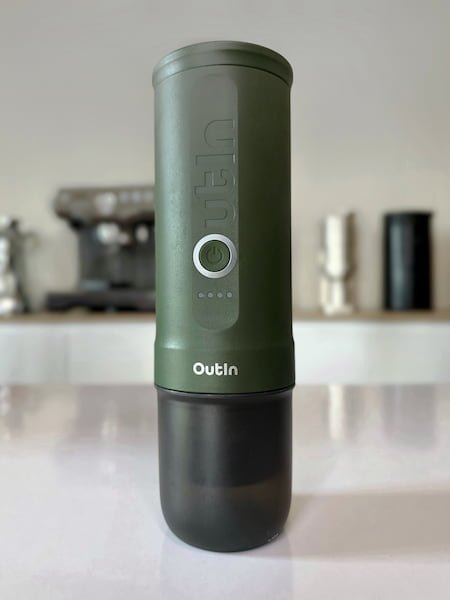
A portable espresso maker that heats its own water on battery power. It takes ground coffee and Nespresso capsules.
Here’s the trick for a lungo. Heat water in your kettle and keep refilling the brewing chamber while the Nano brews. It just keeps dispensing. Brewing style wise it’s technically a “lungo”, but taste wise it’s so close to an Americano
I actually find this tastes very good. With a longer shot, you can grind a bit coarser, and the extraction becomes more forgiving.
Read my full Outin Nano review.
Check PriceAlready own an AeroPress?
Then you don’t need to buy anything. There are two ways to go about it.
- Brew it at Americano strength. Use a 1:10 ratio, something like 15 g of coffee to 150 g of water. That’s already in Americano territory, so you can drink it as is.
- Brew it strong, then dilute. Go to around 1:5, for example 15 g of coffee to 75 g of water, and top up with hot water to taste.
If you want more of the oils and a thicker mouthfeel, get a steel filter screen instead of the paper filters. That gets you a bit closer to the texture of an espresso-based Americano.
You lose the crema. But if you skim the crema off your Americano anyway, like Hoffmann and I both suggest, that’s less of a loss than it sounds.
FAQ
How much water should I add?
For a normal 1:2 espresso, start at 1:3 and taste. Use a scale for both the shot and the water, and the results get a lot more consistent.
Espresso first or water first?
Brew the espresso directly onto the water and you keep the crema, which looks nicer. Add water on top and the crema gets dispersed, which tastes slightly better. Or skim it off completely.
What about light roasts?
Hoffmann suggests pulling a much longer, faster shot: around 18 g in and 60-70 g out. That shot is weaker, so add less water afterwards.
Is a lungo the same as an Americano?
No. In a lungo, all the water passes through the coffee. In an Americano, you add the water afterwards. Different extraction, different taste.
Why isn’t my Americano hot enough?
Usually the dilution water. Use a kettle so you control the temperature, and preheat your cup.
What about iced Americano?
Same principle. Just don’t replace too much of the water with ice. About half of the total volume can still be hot coffee, and it will cool down nicely.

