


Most lists of the best single serve coffee makers look the same. A Keurig, a Ninja, a Nespresso, and a lot of talk about pods.
This one is a bit different.
I’m a licensed Q Grader, I roast my own beans, and I have a counter full of grinders. So I’m not the obvious guy to write about dubious one-cup coffee makers.
But I have tested a good handful of them over the years. And I have a slightly unpopular opinion on the whole category: A capsule machine is better than a bad barista🙅♂️
And a bad barista is… well, most people.
A dirty coffee maker, stale supermarket beans and a random, eyeballed scoop make for a nasty cup. Capsule coffee can beat that easily.
Even instant coffee beats it.
So if you just want coffee and don’t want to think about it, a capsule machine is a perfectly fine answer. I’ll show you the one I’d get.
But if you’re willing to spend two extra minutes in the morning, you can make coffee that is much, much better. That’s what the rest of this list is about. And yes, I’m going to try to talk you into it 😉
Straight to the Point
If you want zero effort, get the DeLonghi Essenza Mini. If you want better coffee and don’t mind two minutes of work, get a Hario Switch and a decent grinder.
- Best capsule machine: DeLonghi Essenza Mini (Nespresso Original). Tiny, ready in 25 seconds, takes third-party capsules
- Best for capsules and real espresso: Outin Nano. A portable espresso maker that takes both Nespresso capsules and ground coffee
- Best one-cup drip machine: Melitta Aromaboy. Possibly the cutest coffee maker in the world. Press a button, get a mug
- Easiest manual brewer: Hario Switch. Pour in the water, wait, press the switch
- Most versatile: AeroPress. Fast, forgiving and hard to break
- Best for hearty coffee: Bialetti Moka Express. Cheap, simple, strong coffee. And built to last.
Capsule Machine or Real Coffee Maker?
This is the decision that matters. The specific model comes second.
Get a capsule machine if…
- You don’t want to geek out.
- You don’t own a grinder (and you don’t particularly want one)
- You’d rather try a few capsule brands than fiddle with recipes.

Get a real coffee maker if…
- You’re fine owning a grinder. This part is not optional. Pre-ground coffee is usually already stale by the time it reaches the supermarket shelves.
- You’ll weigh your coffee and water (or at least adhere to a recipe)
- You’ll clean your brewer.
The uncomfortable truth
If you buy a real coffee maker and skip all three, you’ll make worse coffee than a capsule machine.
Old coffee oils in an uncleaned brewer. Stale supermarket pre-ground. A random scoop instead of a measured dose. That’s a recipe for nasty coffee. I’d take instant coffee over that any day. And a capsule machine beats it easily.
So be honest with yourself before you choose. If you won’t do the basics, the capsule machine is the better coffee maker for you.
How I Chose These Coffee Makers?
These coffee makers are all good in their own, unique way. I have chosen a handful of different categories and styles here, so there’s something for everyone.
Every single brewer on this list can hit a specialty coffee extraction of 18-22%. If a coffee maker can’t do that, it’s not worth your time.
On the other hand, don’t let anyone sell you that number as proof of quality. It just shows the equipment is functioning somewhat okay. Even bad coffee makers can hit it. And actually, it’s mostly a matter of getting the grind size right.
Why I didn’t do a blind taste test
You’ll see other sites line up all their brewers, use the same beans and the same dose, and crown a winner. I don’t think that makes sense here.
As mentioned, these brewers are chosen from different categories. That means they do things very differently, and as such it doesn’t really make sense to compare them. You wouldn’t compare an SUV to a sports car either – you’d only compare it to another SUV.
So doing cross-category taste tests doesn’t make sense in this case. It would actually only obfuscate.
There’s also another reason that you can’t compare my results with your results. I have access to more than 50 grinders at home in my coffee lab. I have expensive aftermarket burrs, and specially formulated coffee water. And more than two decades of brewing experience.
How good I can make something taste at home tells you very little. The real question is how good you can make it taste in your home.
And that depends on three things: the effort you put in, the coffee you buy, and your grinder. If one of those is a weak link, it doesn’t really matter that I had fabulous results with so-and-so coffee maker.
So which one tastes best?
If you truly have a good grinder, good beans, and the patience to make good coffee, I’d personally get the Hario Switch.
But that’s because I generally prefer “filter coffee strength”. In geek terms, that’s around 1.3-1.4% TDS (a measure of how strong the coffee is).
If you prefer a stronger, Americano style cup (which many people actually do), around 1.7-2.2% TDS, you’ll probably like one of the other picks in this blog post. Perhaps even the capsule machine.
So with that out of the way let’s look at some very different, but all potent coffee makers.
The Best Single Serve Coffee Makers
1. DeLonghi Essenza Mini: Best Capsule Machine
The Essenza Mini is the smallest machine in Nespresso’s Original line. It’s about 11 cm (4.3 inch) wide, roughly the width of an old iPhone 4.

It heats up in about 25 seconds. There are two buttons, espresso and lungo, and both are programmable. Hold the button during a brew, release when the cup looks right, and it remembers the volume.
The big advantage is the capsule system. Nespresso’s Original patent ran out years ago, so you can buy capsules from Lavazza, Starbucks and countless supermarket brands. Competition keeps prices down.
The newer Vertuo system only takes official capsules. That’s why I’d always pick the Original line.
So how is the coffee? For a capsule: okay. Actually okay.
The brew temperature is spot on, so you don’t get the sourness of under-heated coffee. If my alternatives were gas station coffee, airline coffee or a neglected office coffee maker, I’d take the Essenza Mini almost every time.
However, it’s not real espresso. I measured a 42-gram shot at 2.83% TDS. A real espresso sits around 10%. Strength-wise, a Nespresso shot lands somewhere between a moka pot and an Americano.
For most people, that’s fine. Real espresso is very strong.
The output also drifts a bit, between 35 and 45 grams around the 40-gram target. A capsule drinker will probably never notice.
There’s no milk frother unless you get the bundle with the Aeroccino.
One confusing detail: the machine exists in two versions, a rounded one from DeLonghi and a boxy one from Breville (the C30). Inside, they’re identical. Pick the shape you like.
Read my full Essenza Mini review.
Check Price2. Outin Nano: Best for Capsules and Real Espresso
The Outin Nano looks a bit like a colorful thermos. I didn’t expect much from the device. But the espresso it makes is very close to what a real espresso machine produces.
The Nano is marketed as a travel espresso maker, but I don’t see why it couldn’t be a more permanent home-solution either.

Fill the device with boiling water from your electric kettle, double-press the button, and it pulls the shot for you.
That means you have less waiting time compared to typical traditional espresso machines, which can take everything from 5 to 25 minutes to heat up.
The Nano also has a self-heating mode, so you don’t need a kettle. However, that mode drains the battery fast, so you only get 2-3 shots per charge. With water from a kettle, one charge lasts much longer. Even more than 50-60 shots.
Another benefit of this gadget, is that it takes both Nespresso capsules and ground coffee. Pop in a capsule on a lazy morning, pull a real shot when you have the energy.
For real espresso, I recommend upgrading to the Nano Basket Plus kit. The basket that comes as the standard only holds 7-8 grams and isn’t qujite worth the effort, in my humble opinion. But with the18 gram basket upgrade, you get much larger and better extracted shots. I was consistently able to hit professional-level extraction yield (around 20%).

Two catches, though: You’ll need a real espresso grinder for the best results with the regular basket as well as the “Pro kit”. And the Nano brews a little cooler than a big machine, so it’s happiest with medium-dark and dark roasts.
At about 660 grams, it travels well. It has already saved me on a road trip in Germany (where gas station coffee is notoriously bad and overpriced).
Read my full Outin Nano review.
10% off with the code THECOFFEECHRONICLER.
Check Price3. Melitta Aromaboy: Best One-Cup Drip Machine
The Aromaboy is quite possibly the world’s cutest coffee maker. It looks like the drip machine from your childhood, just a lot smaller.
It holds up to 330 ml of water and gives you around 290 ml of coffee. One big mug or two small cups.
The spec list is refreshingly short. An on/off button and a hot plate that keeps the coffee warm for about 20 minutes before it switches off.
It comes in black, white and a two-toned retro beige. If you ask me, the retro beige is the only right choice. It just looks so cute and nostalgic at the same time.
However, there are two catches.
First, the brew temperature. In my test, it hovered around 85-88 degrees Celsius for much of the brew. For modern light roasts, you’d want 90-95. In a blind taste test against the Moccamaster, the Aromaboy cup was a bit more astringent. With slightly more developed roasts, this is not a bug – actually it might be kind of a feature.
Second, the filters. It takes small “one cup” filters, also called Melitta 100s, which can be hard to find in supermarkets.
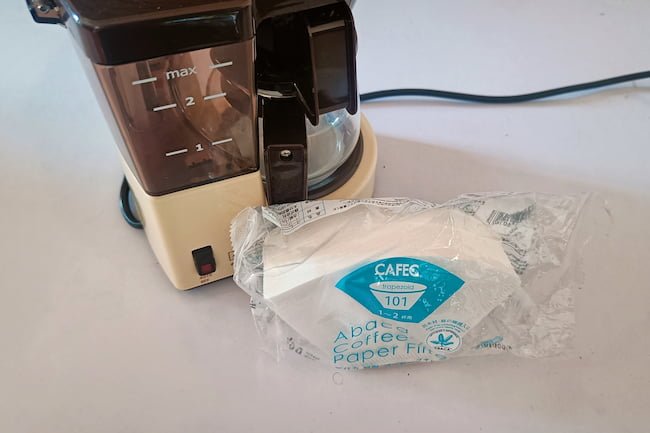
Read my full Aromaboy review.
Check Price4. Hario Switch: Easiest Manual Brewer
This is the brewer I’d hand to someone who wants real coffee without the hassle of pour-over.
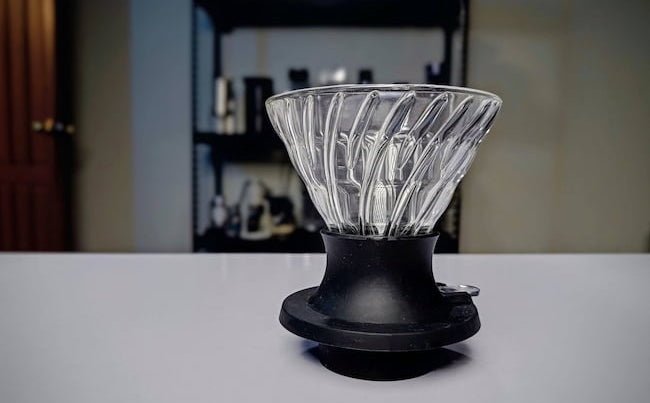
The Switch is basically a Hario V60 sitting on a silicone base with a steel ball valve. Flip the lever up, and the drain closes. Now it steeps like a French press, but with a paper filter.
The lazy method works totally fine. Add all the water at once, let it steep for a few minutes, open the switch. That usually gives you a rather good and rounded cup. You don’t need a gooseneck kettle, nor careful pouring.
But if you get hooked, you can do more advanced hybrid recipes later (check out my quite popular technique on YouTube!)
It takes regular size 02 V60 filters, which are easy to find. Capacity is about 250 ml with the switch closed, so it’s a single serve brewer by design.
The plastic lever does feel a bit flimsy. But it has worked perfectly fine in daily use for years.
There are many devoted Hario Switch fans out there today and I think it’s one of the most beloved brewers among both amateurs and pros.
Read my full Hario Switch review.
Check Price5. AeroPress: Most Versatile
The AeroPress looks funny. A bit like an oversized syringe mixed with something from the toy department. But its inventor, Alan Adler, is also the man behind the Aerobie flying ring, so maybe that shouldn’t come as a surprise.
But don’t underestimate it. It’s more than capable of making delicious coffee. It even has its own national and world championships.
I was a judge at the final of the Indian AeroPress Championship in 2022, and it was a lot of fun, yet serious at the same time.
The brewer relies on pressure, immersion, and percolation at the same time. There are so many ways to brew it. But at the end you force it through a paper filter by pressing down the plunger. Air forces the water through the coffee – hence the name.
The paper takes out most of the oils, so the cup is clean like drip coffee.
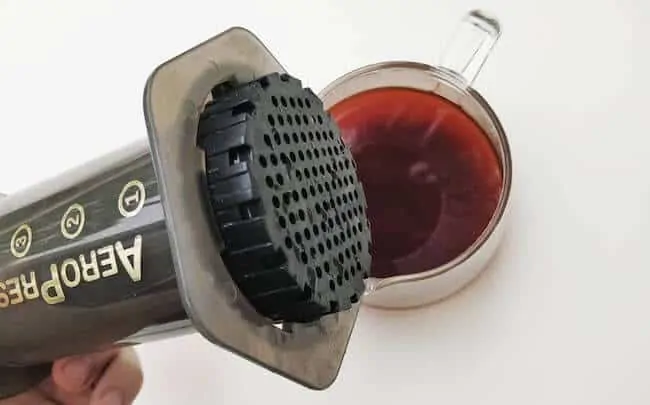
Depending on how much coffee and water you put in, you can have a strength close to espresso/lungo and all the way to more diluted drip coffee.
If you want a heavier, oilier cup, you can get a cheap metal filter disk.
It’s a really flexible way to brew coffee quickly.
And with a million recipes out there, you’ll have a lot of fun if you like to experiment.
It’s made of BPA-free plastic and extremely sturdy. I have never heard of anyone breaking one.
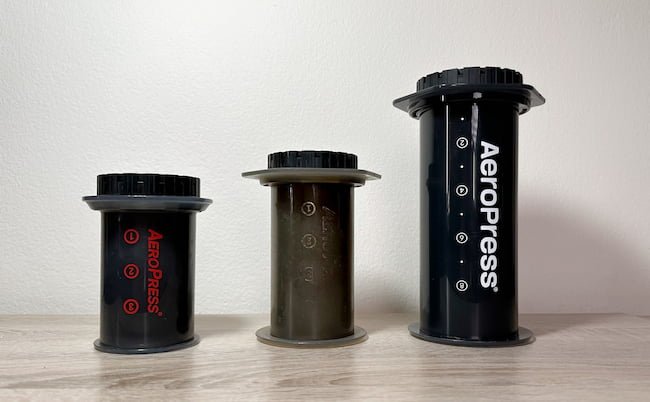
It brews one or two cups at a time. For travel, there’s the smaller AeroPress Go, which I’ll often bring as my travel companion when I’m on the road. But there’s also a bigger XL option now.
Read my full AeroPress review.
Check Price6. Bialetti Moka Express: Best for Strong Coffee
The classic stovetop moka pot. Cheap, simple and it lasts forever.

Moka pot coffee is roughly 4-5% TDS. Strong, but nowhere near espresso. (Interestingly, it’s quite close to what I measured from a short Nespresso shot.)
So if you like strong, intense coffee, this is a cheap way to get it. Drink it straight or dilute about 1:1 with hot water for more of an “Americano” style experience.
There’s no paper filter, so you get more oils and a bit of sediment. A heavier cup.
Bonus tip: if you want to cut down on the cholesterol, you can easily use an AeroPress filter, just wet it and attach it to the shower screen and then you will get a cleaner cup.
For single serve, get the 1-cup or 3-cup size.
Read my full Moka Express review.
Check PriceWhat I Left Out (and Why)
I considered all of these, and I’ve used most of them. Some of them I really like. They just aren’t the right pick for this article.
Clever Dripper. A totally fine brewer. But the Hario Switch does the same thing, and I think it does it better. You can change the order of immersion and percolation, which gives you more brewing techniques. The Clever is a bit more primitive.
Hario V60. Probably still my top favorite pour-over. But it takes some technique, and ideally a gooseneck kettle. If you’re already a pour-over fan, skip this article and go straight to my roundup of the best pour-over brewers.
Leverpresso and Picopresso. Great little espresso makers. But you need an espresso grinder to get the best out of them, and you need to study espresso extraction a bit. Too much homework for people reading this article.
Moccamaster Cup One. Too expensive for what it is. Essentially, it’s a hot water pipe spraying water straight down on the coffee. You can get cheaper machines that do the same thing.
Breville Barista Express. A fully fledged espresso machine. I wouldn’t call that a single serve coffee maker. (My Barista Express review)
What About Keurig and Ninja?
These two dominate most single serve lists, especially in the US. You won’t find them on mine.
The reason is simple. They’re hard to get in my part of the world, and I don’t have a strong desire to try them. I only recommend what I like and have used myself.
What Actually Makes a Good Cup
The brewer matters less than most people think. Here’s what matters more.
The grinder
The moment you leave capsules behind, the grinder becomes the most important piece of equipment. You cannot skip it.
You don’t need to spend a fortune. A decent hand grinder is enough for any brewer on this list.
Water
A cup of filter coffee is around 98.5% water. Yet most people never think about it.
If your tap water is hard, your coffee tastes flat and your machine scales up. Soft water around 50 TDS is a good starting point.
For capsule users, I’ll be realistic: you probably won’t bother with special water. That’s fine. Just descale the machine when the manual tells you to.
Cleaning
This is important with every coffee maker, capsules included.
Old coffee oils build up and taste stale and bitter. Rinse your brewer after use, wash it properly once in a while, and descale if the machine calls for it.
A dirty machine ruins good beans. Every time.
Cost per cup
Specialty coffee snobs like me love to point out that capsules are expensive per gram of coffee. That’s true.
But with real coffee, you also need a grinder, a scale and some patience. With a capsule, there’s no waste from dialing in.
Third-party Nespresso capsules bring the price down a lot, compared to the originals from Nestlé.
FAQ
What is the best single serve coffee maker?
For zero effort, the DeLonghi Essenza Mini. For better coffee with a little effort, the Hario Switch paired with a decent grinder.
Is Nespresso real espresso?
Not really. A standard 40-gram Nespresso shot measured 2.83% TDS in my test. Real espresso sits around 10%. It looks like espresso thanks to the crema, but it’s closer to Americano strength.
Can I use third-party capsules in a Nespresso machine?
Yes, in the Original line. The patent ran out years ago, so brands like Lavazza and Starbucks make compatible capsules. The Vertuo line only takes official capsules.
Nespresso Original or Vertuo?
Original. More capsule choice and lower running costs.
Do I need a grinder?
With a capsule machine, no. With any real coffee maker, yes. Pre-ground coffee goes stale quickly, and the grinder makes a bigger difference than the brewer.
Is capsule coffee better than drip coffee?
It depends on who makes the drip coffee. A well-made cup from fresh beans beats a capsule easily. A cup from a dirty machine with stale beans doesn’t.

